
Trace Kent County Former Owners
The newest deed is the best starting point. Its grantor was the prior owner. The legal description defines the land that passed. Many deeds also recite that the tract is the same land conveyed in an earlier book and page. One such reference can move a Kent County property records search back a full generation without relying on a street address.
| Record layer | Known span | Access point | History clue |
|---|---|---|---|
| Modern electronic deed index | COTT 1978; CAIS 1993; ELROI 2005 | MdLandRec or courthouse terminal | Indexed parties, recording date, instrument, book/page |
| Historical land indexes and books | Land records from 1636; general index from 1656 | Circuit Court Clerk and Maryland State Archives | Earlier conveyances and legal descriptions |
| Recorded plats | Varies by series | Plats.net, clerk, and Archives | Lot, block, roads, easements, and subdivision name |
| Kent estate files | Estate Search 1998-present; older files vary | Register of Wills and Archives | Authority behind estate-related transfers |
Always use the newest source first. A current SDAT card supplies a deed reference, yet the deed image itself controls the backward path. Once the trail precedes the modern Kent County index, shift to historical indexes and cited volumes. A blank online result does not end the chain.
Start With Kent County's Newest Deed
The SDAT Real Property Search can find a Kent account by address, street, account or PAN, or map reference. Owner-name searching is not supported. From the result, copy the owner name, deed reference, sale date, premises address, legal description, and map-grid-parcel fields. Those details keep similar names apart.
Before opening Kent County's indexed land records, researchers pass through the MdLandRec login and search entry, the account gateway for the deed image system. That gateway guards the records.
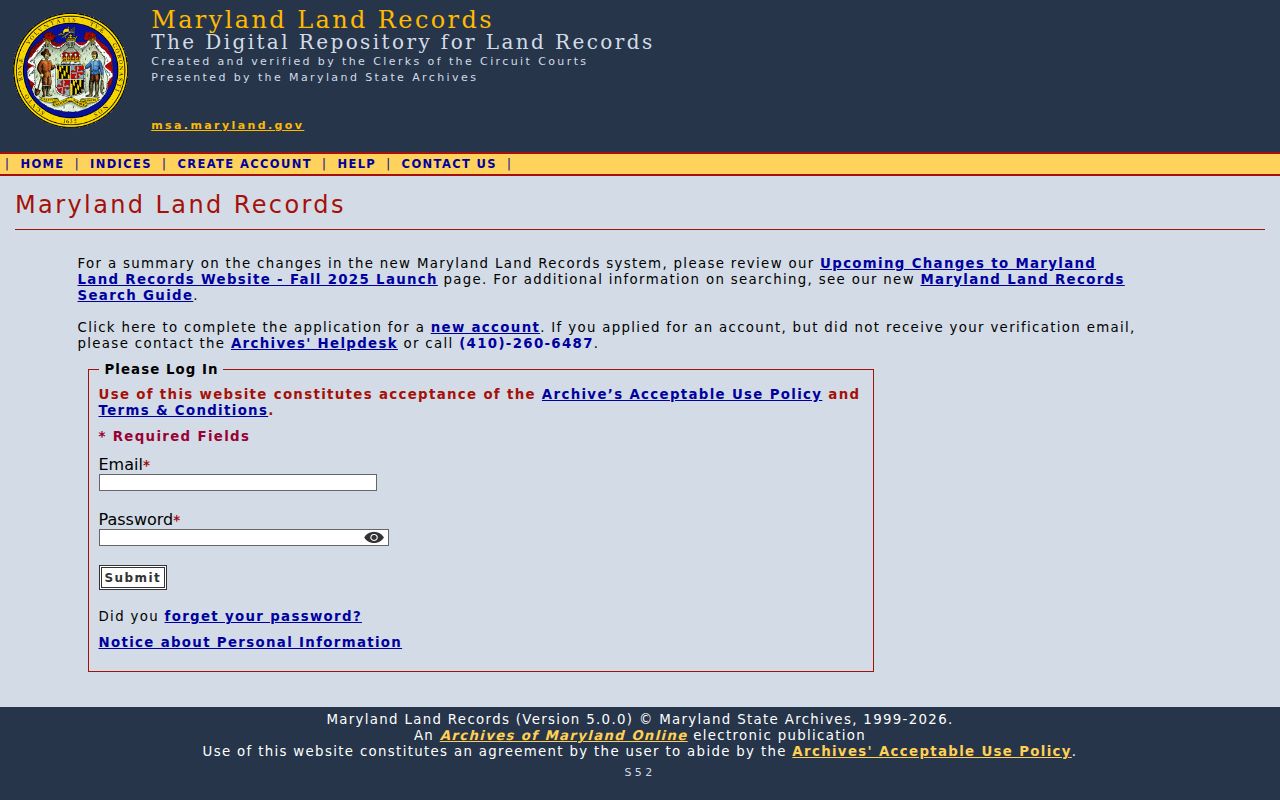
Next, open the deed reference in MdLandRec. Read the whole image. It shows the parties, consideration, legal description, exceptions, and any prior deed citation. A sale date on SDAT is generally the deed record date. It is not the private closing date. That recorded deed is the soundest first link to previous owners.
Kent County's 1978 Online Divide
Kent County land records reach back to 1636. The current electronic run does not. The Maryland Land Records Search Aid identifies COTT beginning in 1978, CAIS in 1993, and ELROI in 2005. Those labels mark successive index systems, not the start of county deed records.
Time-depth key. Treat 1978 as the effective start of the modern electronic run; use historical indexes, deed books, the clerk, or Archives for earlier owners.
That distinction prevents a common mistake. A empty result in the newest interface may simply mean the name sits in a retired index, carries a different spelling, or lives only in a cited volume. Save each system label as you move backward. Add the liber, page, and date too.
Rebuild Kent County's Deed Chain
Each seller is a clue. In a backward deed chain, that seller points to the next older acquisition. MdLandRec accepts individual and corporate names, grantor or grantee roles, date ranges, name operators, document context, and direct book and page jumps. Search the cited reference first, then fall back on the party index.
- Find the newest acquisition deed, where today's owner appears as grantee.
- Record its grantor, legal description, date, instrument type, and book/page.
- Follow the “being the same as” citation or search that grantor as an earlier grantee.
- Repeat while matching the land description, then switch to historical indexes before 1978.
- Grantor and grantee
- The grantor conveys an interest; the grantee receives it.
- Chain of title
- The ordered sequence of instruments affecting ownership of the same land.
- Reverse index
- An index arranged by the seller or grantor, useful when tracing backward.
- Warranty and quitclaim deeds
- Different forms of conveyance; neither label alone proves a complete title chain.
Read Kent County Prior References
The most useful sentence in an older deed often begins “being the same as.” That phrase points to an older book and page. MdLandRec's Book/Page Jump opens a known reference directly. The image reveals the scope. It shows whether the cited instrument covers the whole parcel, a larger parent tract, or only one interest.
Never match on a name alone. Compare acreage, lot and block, subdivision, adjoining owners, road or creek names, and deed calls. Kent County waterfront and farm land can keep an old tract name long after the premises address changes. Some parcels were split from larger tracts named earlier.
Kent County's Typed Colonial Books
Kent's first eight land books took an unusual path. Annapolis held the originals at the Hall of Records. Sarah Elizabeth Stuart transcribed them in 1928 and 1929, and the copies were typed and checked in 1934 under a CWA project. The Kent Land Records historical page identifies Liber A through the early numbered volumes and their overlapping date spans.
A typed copy can preserve a deed chain while quietly introducing spelling or abbreviation differences. Search the historical index, then inspect the cited volume. Liber A spans 1636 to 1679. Other early books overlap. Note whether the evidence came from an original, a transcription, an index, or a later image.
Kent County Probate and Plat Links
Not every ownership change shows up as a simple sale. Kent County land can pass through probate, survivorship, a trust, or a personal representative's deed. Maryland Estate Search covers 1998 to the present. Older files remain with the Register of Wills or the Archives. A probate file grants authority. A recorded deed still confirms the land transfer.
Plats fill a different gap. A recorded subdivision or survey plat can tie a former tract description to a later lot. It may also cover a block, road, phase, or common area. Pull the plat reference from SDAT or a deed. Then compare it with the county parcel. That evidence matters most when a former owner held the larger parent tract.
Kent's Register of Wills can also name the personal representative behind a conveyance. It can supply the estate number, too. Its Chestertown office sits at 103 North Cross Street. Older estate material may require the local file or the Archives. Estate Search is a public lead. It is not proof that a named beneficiary became the owner of record. Confirm the later personal-representative deed, distribution deed, or survivor instrument in the deed records.
When Kent County Names Fail
Historical indexing reflects the name written at the time. Try spelling variants. Search corporate names separately. MdLandRec offers Begins With, Contains, Fuzzy, and Soundex operators. A spouse, successor entity, personal representative, or trustee may appear in the instrument even when the expected owner string does not.
The official index can show Date Recorded, Grantor or Grantee, and Instrument Type. It also lists Book/Page, Remarks, and an information control. Categories include deed, deed of trust, release, assignment, easement, and power of attorney. Watch for exceptions marked *NO DESCR* or *NO NAME*. They are a signal. Inspect the image and its surrounding entries before abandoning the property search.
Legal land clues often beat surnames. Search the same book/page, plat, tract name, parcel history, and adjoining-owner calls. For anything past the portal, the courthouse terminal and Land Records Department remain available. The Maryland State Archives Kent guide lists retired land indexes, plats, probate series, and microfilm.
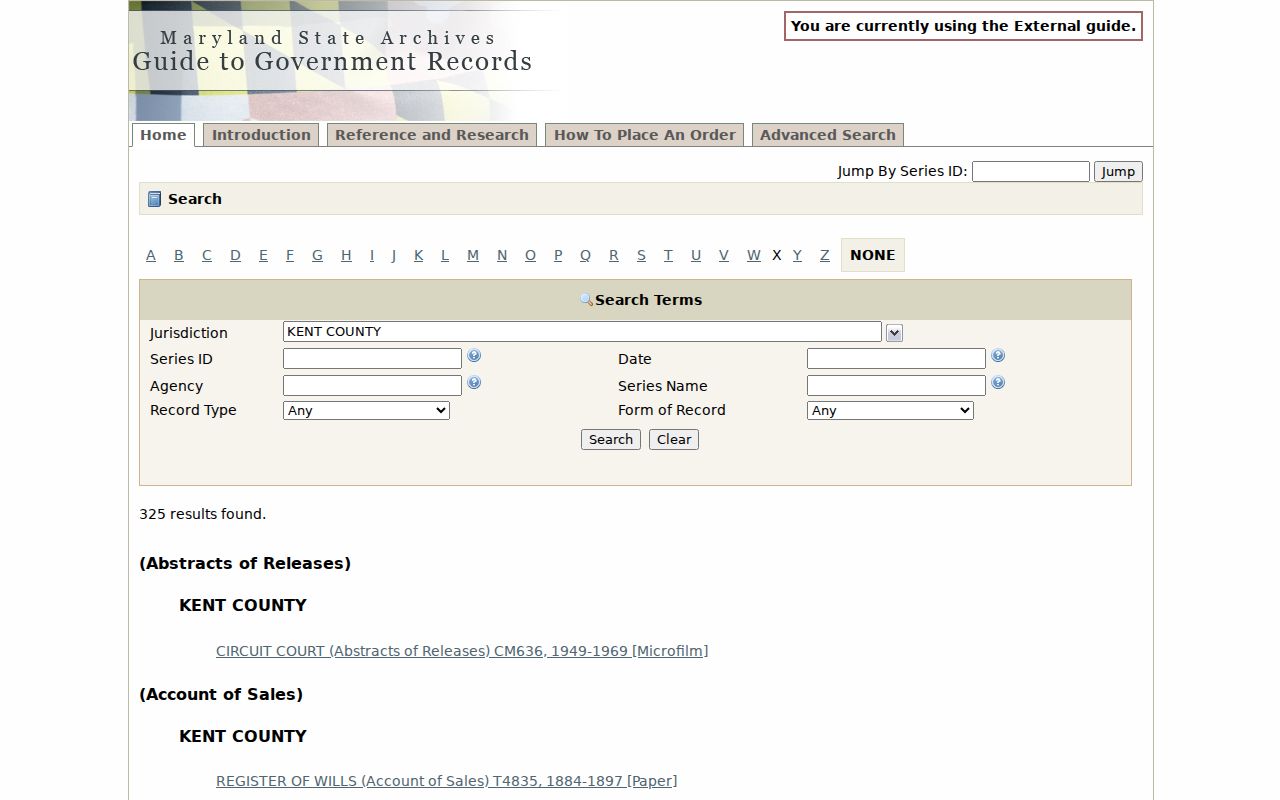
The Archives guide makes the fallback concrete. Older Kent County ownership work moves by named series and date span. The Kent County Public Library Maryland Collection and Chesapeake Heartland add family and community context, but they do not replace the deed chain.
Kent County Ownership Reaches 1636
The record series begins in 1636. General indexing starts in 1656. The courthouse moved from New Yarmouth to New Town in 1697 and burned in 1720, so date-aware research beats any claim that every modern parcel has one seamless online chain.
When a volume or image is missing, start with the citation. Ask the Clerk of the Circuit Court for Kent County or Maryland State Archives. The Land Records/Licenses number is 410-778-7460. That call is often the fastest route. Give the party names, roles, date range, instrument type, book/liber, and page. A narrow request works better. It beats asking for every prior owner at once.
Online search is one channel. A free MdLandRec account provides the web index and verified images. The courthouse counter or terminal handles retired indexes and difficult entries. Archives finding aids and microfilm extend the chain when a volume leaves active custody. KCPL and the Historical Society supply directories, newspapers, and local names that help resolve identity, yet a deed or probate instrument must anchor any ownership claim.
Lawful use. Kent County former-owner records support house history, estate work, and property diligence. Never use them to track, target, or harass a living person.